Wednesday, 24 April 2013

Sheffield based chamber music organisation Music in the Round are holding a Silent Auction during the week of the 13th May (the week of their annual May Festival with a series of concerts at the Crucible Studio in Sheffield). This Auction of sculptures by artist Vivien Whitaker will raise money for the Ebony and Ivory Fund to buy a new piano for the organisation.

Over the next few weeks I will be posting images, sound and video relating to the sculptures and 'days' featured in this auction, as well as talking about my own impression of the pieces. I would love you to get involved and comment on the works, maybe describing what you see in them and what you think of them.

For more information on how to bid for these sculptures/days please go to www.musicintheround.co.uk/silent_art_auction.php.


Thursday, 11 April 2013

‘Becoming Picasso’ at the Courtauld: How grief makes for really great art


There is no denying that Pablo Picasso – who died forty years ago this week – was an extraordinarily talented young man. His dedicated museum in Barcelona reveals that he could appropriate the great masters like Michelangelo and Vermeer whilst still a teenager, and the fact that he never stuck to one style for very long is testament to the versatility of his abilities. A new exhibition at the Courtauld Institute at Somerset House in London offers a focus on his output from just one year, 1901, and presents an interesting transition from appropriation to an uncertain individuality.


In 1901 Picasso moved to Paris, having been promised an exhibition by the dealer Ambroise Vollard in his gallery on the Rue Laffitte. He took a studio in Montmartre and set to work producing paintings for this show: the final number exhibited was 75 and media from the time reports that Picasso worked at immense speed, sometimes painting three canvases a day. These works can be found in the first room of the exhibition ‘Becoming Picasso, Paris 1901’, and show an incredibly talented painter, with a striking sense of colour and form, but with few ideas of his own. The nineteen-year-old Picasso had absorbed so much of contemporary art – as well as works from the art historical canon – and was creating work that constantly referenced other people’s ideas.  One work (which actually is in the second room), called ‘The Blue Room (The Tub)’ illustrates this well. In it the rug belongs to Vuillard, the bath to Degas, the female figure to Vlaminck or Matisse, and the poster on the wall in the background to Toulouse-Lautrec. All these pieces of iconography are – of course – likely to recur in art of this time, but it is not just the theme that Picasso appropriates, it is the style.


Picasso was good. Really good. But he knew it, and unfortunately confidence and assurance do not often – in my opinion – make extraordinary art. It is the fragility, the nervousness in works that make them so thick with thought and feeling. It is often where something is very hard – either literally in terms of difficultly drawing, or in terms of expressing an emotion – that the artist end up recording more of themselves in the artwork, making it infinitely more absorbing for us, the spectators.

With this in mind, to me, the second room is infinitely more interesting. This is the room of paintings done after the summer exhibition at Vollard’s gallery, and it seems that without the pressure of needing to produce works to display, impress and sell, Picasso felt able to explore the more private and personal ideas within him, and in this we have the birth of the ‘blue period’.

If you are only familiar with Picasso’s brilliant and distorted paintings from the middle of his life, or with the cubist pieces from the 1910s I would urge you to familiarise yourself with his ‘blue’ and ‘rose’ periods. These works are devastating in their anguish and deep sadness. Ordinary people caught in a moment of thought form the basis for many of his works in this period, and this subject may have been a direct result of the impetus for this aesthetic: was he really exploring the inner sadness of someone else as he drew his models?

In the beginning of 1901, Carlos Casagemas – a friend of Picasso’s – shot himself in front of a group of friends in a cafe in Paris. Picasso was in Spain at the time (something that he may have carried guilt for), and felt the loss of his friend keenly. Interestingly, though Picasso was open about many biographical details concerning his friendships and lovers, he did not reveal that the death of Casagemas caused the change in his style in 1901 until the 1960s. We know that the young Picasso was quite secretive (when his monumental ‘Demoiselles D’Avignon’ met with shock from a few of his friends he hid it away for six years), but there is a sense that in this case, he might have felt regret or shame in not being able to help his friend. He searched the souls and hardships of others, in the way he perhaps should have done with Casagemas.

All this is speculation, but several works from the Courtauld exhibition see Picasso playing out his grief in his work. The most obvious of these is ‘Casagemas in his Coffin’, in which the head of a man lies enveloped by white sheets with darkness surrounding. This is an extraordinarily powerful work, in which Picasso reduced the palette entirely to blues, browns and white. The blues are rich and electric; there is a strong intensity of feeling in the work, and the paint is layered in thick empasto which is fairly unusual for Picasso in this period. We feel the energy and desperation in each brushstroke, and yet the subject is cold and still. Picasso exaggerates the upper lip of his friend, in the way that he would go on to exaggerate fingers and chins in other blue period portraits. Here we find the beginnings of Picasso using physiognomy to draw out expression and character.


In this second half of the exhibition we find ourselves forming a portrait of the teenaged ‘genius’. As well as the works that directly reference Casagemas and the melancholy harlequins – who recurred frequently in his blue and rose periods – we find a recurring theme of care. Two works (which appropriate the style of Daumier) show a mother and child, and the famous ‘Child with a Dove’ drives the point home as a fragile and awkwardly positioned young girl stands, carefully cradling and protecting a dove. Surely these are unusual subjects for an ostentatious, 19-year-old man?


Two self-portraits give us a greater sense of his personality. Both named ‘Yo – Picasso’ (‘I – Picasso’), one is large and confident in presentation, while the other offers just Picasso’s face, almost shyly etched onto a canvas. In the first of these, he appropriates Velasquez, depicting himself as the Romantic Artist with a billowing white shirt and orange cravat. The rich blues of the background are reminiscent of Van Gogh’s palette, and the unusually wide ear might be a reference to Van Gogh’s powerful late self-portraits (done after the severing of his ear). However, in the face of this portrait, and in the smaller one, there is a distinct anxiety and unsureness. He is wide-eyed and open: a young soul in an older body.


This exhibition is small with just 20 pictures, and is perhaps not worth the £6 entrance fee (though it is free for full-time students), but if you already hold some level of information about Picasso and an interest in who he was then I would recommend a visit. Picasso does not often reveal to us his fragility, but a display of a talented painter struggling to find his brilliance is an extraordinary thing to behold.

Sunday, 24 February 2013

Beyond Redemption: Redon’s church interior


Odilion Redon (1840-1916) was an intriguing artist. Working through the turn of the century, he often engaged with the nineteenth-century fascination with ideas of evolution coupled with fears of degeneration. With the awareness of Charles Darwin’s theories of how man developed also came a fear that perhaps mankind could ‘evolve’ into something less intelligent. The medical sciences were advancing in their understanding of hereditary conditions and so a kind of inversion of Darwin’s theories where the defects of an individual were passed on rather than their strengths became a fear that was felt by many.

Redon made his name through his Noirs drawings. Entirely monochrome, these works explored ideas of botany and evolution, whilst always giving the ‘creatures’ a human and empathetic quality. From the 1890s, Redon began displaying works in colour (previous to this he had only exhibited his Noir works). These pieces engaged more with spiritual ideas. Around him were artists and radical thinkers of the age who were slowly converting to Christianity, and who turned their evangelistic pressures onto Redon himself. In the 1890s Joris-Karl Huysmans, author of the controversial ÁRebours and friend of Redon converted, while the artist’s friend and patron Gabriel Frizeau put continual pressure on Redon to convert to Catholicism.* Through his production of the 1890s it could be argued that Redon was working out his interest in religion and attempting to reach his own conclusions about a spiritualism that he could engage with. Eventually Redon came to believe that the Eastern religions of Buddhism and Hinduism had more ‘truth’ in them than the conservative Christianity of the West; however, in all of these philosophies it was their other-worldly aspects and spirituality which attracted him, rather than their moralistic approach to life.


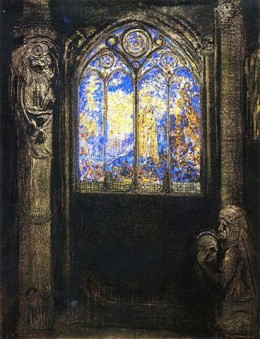
Le Grande Vitrail (1904, another work in the Orsay in Paris) seems to me to encapsulate this sensibility in Redon.  This work draws attention by the brilliant blues of the glass in the large stained-glass window that is the subject of the work. Redon’s colour pastels are characterised by a luminosity which immediately gives them a transcendental spiritual element; these works are not about the physical and material, they ask us to consider the unseen truths in the world around us. In Le grande vitrail Redon combines the dark materiality of his Noirs with the transcendence of his colour images. As the viewer looks beyond the attractive colour in the window, the dark themes of the ecclesiastical interior come into focus. It is almost as if Redon is attempting to trick the viewer to engage with his dark works: the creatures that he includes carry a sinister gothic horror.

Kneeling in the foreground are two children. We believe them to be children by their size and proportions, and the way in which they cling to another, as infants do. However, Redon replaces both the children with metaphors: one has a grief-stricken face which appears somehow older than her body suggests, and from her back are the suggestion of angelic wings, while the other’s head is replaced by a hollow skull. These beings represent a kind of half-life. They foretell of creatures in the Afterlife: what they will become. Given the contemporary interest in disease and decay, it could be assumed that the hopelessness of these beings relates to physical defects; however, the juxtaposition in this work with heavily Christian spirituality suggests something more philosophical.

Diagonally across the image from the two infants is a carving in the stone of the pillar to the side of the window. This presents a Madonna cradling the infant Jesus. She curls from the top of her spine so her head covers the child in a protective embrace. This scene exists outside of the safety of the heavenly realm which is presented in the window, and there is the sense that the Madonna – finding herself in the dark earthly realm – is desperate to protect her son from the threat around. This threat exists in the shadowy corners of the periphery of the work. As with James Ensor’s work Redon hides a series of disturbing faces amongst the stonework of the church. Gargoyles look down upon the scene from the top of the tall pillars, and where the decoration at the top of the Corinthian columns either side of the window should be gentle curls, instead Redon draws in a group of skulls. Below the window is a tomb, and at the top right the figure of a man silently and morbidly views the scene, unable or unwilling to intervene by moving past the pillar which segregates him from the main part of the composition.

Meanwhile, just off-centre in the window itself stands the man Christ. He appears passive with his hands crossed in front of him, and his head turned slightly heavenward. Around him a few figures kneel and gaze up at him, while the brilliant blue of the background is offset by Redon’s characteristic metallic gold, suggesting clouds of angels behind him. This window does not seem to present the earthly realm; it may be a heavenly setting, or the collision of heaven and earth that the Bible foretells. Either way it is wholly inaccessible to the material world that Redon presents around the window.

This image could be read as a presentation of hope and redemption in the promise of salvation through Christ; however this interpretation would deny the clues that Redon leaves that suggest something darker. Neither the carved Madonna, nor the crouched infants in the foreground engage with the window. They do not see the figure of Christ as a promise of redemption. Instead this work seems to suggest that the earthly world is too damaged for the hope of Christian salvation to apply anymore. The children are already becoming damaged creatures of the afterlife, despite their innocence (which is suggested by the wings). Disease and decay – symptoms of the fallen world – have taken hold of contemporary society; how can the heavenly scene in the window have any relevance to them. The brilliant colours of the stained glass allow no light in to shine upon the scene within the building.


*Frizeau always believed that Redon’s work was ‘implicitly Catholic’, though Redon himself never carried these personal convictions.

Starry Night: Spirituality in an ‘aesthetic emotion’


In 1914 Clive Bell published an essay in which he declared that the highest art genre was the one that embraced the idea of ‘significant form’; an abstraction which inspired the ‘aesthetic emotion’ in those of us who have the profundity to appreciate art. There is much to be said about this idea, and in my first entry for this blog I argued that rather than making art more elitist, there was a potential for abstraction to make art more democratic. However, I believe that if ever there was an artist who proved there to be such a thing as the ‘aesthetic emotion’, and one which could be experienced by anyone, it was Vincent van Gogh.


There is just something about van Gogh. I don’t believe I have ever met a person interested in art who did not name van Gogh as one of their favourite artists. In some way he speaks through his insanity and his heavily stylised works to something vital in the human condition. This is an idea which I hope to consider more deeply in another post, however, returning to the idea of the ‘aesthetic emotion’, I would like to bring forward one of the greatest works in the collection of the Orsay: Starry Night, Arles.


This work presents a night-time river scene in Arles, in the South of France. In compositional terms the work adopts established theories and conventions in art practice. The painting plays upon the complimentary colour combination of blue and orange,* but van Gogh makes the work slightly colder by mixing in an acidic yellow. In terms of form, van Gogh frames the work by darkening the area around the top of the work, and through the inclusion of the grassy riverbank in the foreground. However, these components merely lay the foundations for a truly exceptional work.

The real strength of many of van Gogh’s paintings – something that can only be appreciated when directly in front of the work – lies in the facture of the paint. Van Gogh truly delighted in the medium of his work, and he applied his paint thickly, almost sculpting the scene in low relief. In this particular work, the expensively designed lighting scheme of the gallery directs whites on the brushstrokes from above, thus the lighting on the river highlights the ripples across the water. It would be nice to believe that van Gogh intentionally sought to use the environment in this way to describe the scene he depicted.

This work holds the hint of a narrative. At the head of the riverbank in the foreground are two small boats, the peasant couple on the verge before us walk away from the water; the suggestion is that they have travelled across in one of the boats, an idea which is encouraged by the darker ripples which lead from the back of the boat to the edge of painting. There is a discrepancy in this though: the couple appear old and haggard, they certainly do not look as if they would have the strength to row a small fishing boat. The juxtaposition of these people within this spectacle of a night setting makes the background even more magnificent.


These broken people appear several times in van Gogh’s work. His The Potato Eaters (1885) reveals up close the battered figures of a French peasant family. Their skin is hardened and their bodies slightly deformed by the labours that encompass their existence. This work seems to be part of the atheistic concern for ‘matter’ that Gustave Courbet introduced in the controversial Burial at Ornans, and yet van Gogh relates the scene by the clean light from a single lamp in the upper centre of the work.

The figures in the foreground of Starry Night, Arles are a metaphor for us. The broken, worldly beings that stand encased by this magnificent and glorious scene. It is not a coincidence that I am drawing upon Christian imagery here; van Gogh was a religious man who for a time sought to serve in the Church, and indeed this work could be seen as an analogous illustration for ‘light shining in the darkness’ (John 5:1). The way van Gogh uses lines to evoke the glow of the stars seems almost childish, but in doing so he indirectly references their creator; he – the creator artist – relied upon his linear brush to describe what he sees, the creator God’s way is more perfect. The idea of people as lights in the world is suggested below the whiter heavenly lights of the sky in the man-made lights of the town. These lights are not so pure, and often they are muddied by the shadows of the urban setting, again presenting the idea that man’s way is imperfect.

Here I return to the idea of the aesthetic emotion. If there is any way of explaining this phenomenon it is to equate it with a spiritual experience. This painting is ‘magical’. There is a magnetic pull about the piece, as if it desires to draw you into it; to fully immerse yourself in the scene. It is not just beautiful, it is heavenly. It humbles us in our human states, yet – as with all van Gogh’s works – the scene is viewed through the lens of a very human soul. The wonder and awe of a simple night-time scene floods our senses as the stars flood the clouds of pollution with a bold pigmented blue light.


* Van Gogh would have been aware of the colour theories of Post-Impressionist and Pointillist Georges Seurat, who developed a technique of applying unmixed colours to his canvases in small dashes which would then be mixed by the eye. The theory and practice of using complimentary colours became more widely used by Post-Impressionists such as van Gogh.

Sunday, 17 February 2013

Vulnerability and Threat: Sickert verses Ensor


I wonder how often Walter Richard Sickert and James Ensor have been considered alongside each other; true they are not so far apart in terms of history (they were both born in 1860 and lived until the late 1940s), and true Sickert spent some time in France in the 1900s before returning home to produce the controversial works of contemporary London, but it was not until I stumbled across Ensor’s La Dame en détresse (1882) in the Musee D’Orsay that I recognised a potential for visual comparison between the production of the two artists.

At face value this is to be found in similarities of subject: La Dame en Détresse portrays a woman collapsed on a bed, with curtains closed and details of her person masked by the manner of painting. This subject immediately conjures the association of Sickert’s Camden Town series, a set of works which give account of a very particular incident.


Walter Richard Sickert was a British artist trained by James McNeill Whistler, who had encouraged him to travel to Paris. Whilst there he became fascinated with the force of Modernism, as exemplified in the work of Edouard Manet and the biting realism of Edgar Degas. Returning home to London in 1905 Sickert found it a centre for a similar cultural Modernity to that which he had encountered in Paris, and to which the French artists were so brilliantly responding. In line with Charles Baudelaire’s The Heroes of the Basement Sickert lived a working class life in Camden Town, and he chose the working class people over the bourgeois as his subjects. However, this decision was not quite as refreshing as one might first think; what Sickert delighted in was the vulgarity of this life; he does not paint ordinary life in order to dignify or monumentalise it, he is simply fascinated by the grim details of the ordinary existence.

This vulgarity reaches their extremes in the Camden Town Murder paintings. The brutal murder of a young woman called Emily Dimmock – who sometimes made ends meet through prostitution – shook the general public and became a piece of fascination for the popular press. The memory of Jack the Ripper’s savage crimes were still present in people’s consciousness, and in no-one’s more than Sickert who had always been obsessed with these murders. Dimmock became a kind of perverse muse for him. He rented the rooms in which she had been killed, and even hired the defendant in the case after he had been acquitted to pose as a model for his paintings. These paintings are comparable to CSI: each item in the room is placed there for some reason. In each work he reconstructs the murder scene placing a different emphasis or interpretation on the event; his muse takes on the role of victim or whore.

Taking Camden Town Affair (1909) as an example, Sickert turns a work which initially seems to present a nude asleep into something more aggressive by the confrontational placing of the viewer within the scene. We stand at the end of her bed, viewing the women in a way which not only distorts the appearance of the body through the foreshortening, but also accents her sexualised areas. Sickert helps this along by highlighting these areas with touches of lightness. The nudity of this woman is not remotely desirable or erotic, rather her naked state emphasises her vulnerability. The shadowy figure of a man fully clothed by her bedside accents this vulnerability whilst also placing us as the viewer in an uncomfortable position; why are we privy to this scene? And is it possible that we are the ones who threaten the vulnerable woman?

Walter Sickert, Camden Town Affair, 1909

Of course to the informed viewer this woman is not sleeping. The distortion of the woman’s limbs give this away; her positioning is not one which anyone would naturally lie, whether awake or asleep. This arrangement testifies to the struggle of defence which concluded with her loss of life. This struggle is communicated in the painting of the room. While in one way the scene radiates silence, the surroundings – the bed, the floor, the walls – scream out the drama which they have witnessed. Sickert’s brushwork on the sheets of the bed is erratic and disturbing; the floor colour is clearly painted over black as if trying to cover over the horrific secret.

This was an unsolved murder trial, only the physical setting of the room could testify to the identity of the murderer.


As the title suggests, Ensor’s subject is not a corpse. Though her form is limp and passive, we are told that she is ‘A Woman in Distress’. Rather than testifying to a physical crime, this scene seeks to present an internal turmoil.

James Ensor, La Dame en détresse, 1882

While Sickert played upon the obsession with crimes of the popular press, Ensor chose to present Modernity is quite a different way. As an artist he is well known for his masked caricatures of crowded groups. There were various theories which were popularised in the second half of the 19th century concerning the impact of the urban environment on Mental Wealth; these included Georg Simmel’s The Metropolis and Mental Life (1902-3) as well as the theories of behaviour within crowds by Gustave Le Bon and Sigmund Freud. Ensor plays upon these theories in his art. In Self Portrait with Masks (1899) he relays the loneliness and claustrophobia of the individual within the city crowds by filling the space with dehumanised forms of people; the extremism of these beings suffocates the realism of the artist’s own portrait in the centre of the work.

 
James Ensor, Self-Portrait with Masks, 1899

All this made it surprising to find a work so seemingly ‘conservative’ as this one. However, as with Sickert’s work, it is the subtleties of the painting which when revealed make it so disturbing. A close inspection of the iconography reveals ghoulish faces hidden across the painting: in the bed-knobs, the curtain ties, the carvings of the bed. These mystical clues indicate how we should read the interior scene we see.

Several Symbolist artists were interested in the representation of urban anxieties through the analogy of the interior of a room and the interior of a mind. Vilhelm Hammershoi is one such example of this; his empty interiors often include a single figure with her face obscured, and all the routes of escape from the space are blocked. In Woman Reading the lines of perspective of the object in the room are exaggerated to a vanishing point by the woman’s head, thereby directly referencing her psychological character, and the door is closed in on us so the only space we are aware of is the one room. The suggestion is that this woman in some way feels trapped within her mind, isolated from the world by her invisibility within the urban environment.

Vilhelm Hammershoi, Woman Reading, 1908

It is likely that this is just what Ensor looks to achieve in La Dame en détresse. We notice that the curtains are closed upon her, and where they are open we are not permitted any view of the world beyond. The title claims that this woman is in ‘distress’ but the woman herself is passive and still – the active angst of the work is to be found in the enclosure of the darkened bedroom. The figure of the woman herself is almost formless: her body has collapsed completely into the bed so, were it not for the colour of her clothing, we might not be able to distinguish her form. The subject is not aware of her physical self within the Modern city: the contemporary fashion which she wears which might bring her a sense of belonging is dematerialised and instead we see only the internal feelings of being haunted by urban anxieties which threaten that sense of belonging.


The comparison of these works reveals a commentary on the modern woman in the urban environment at the turn of the century, but the most interesting aspect of both these works is both artist’s choice to present the woman within the private space of her bedroom. It is here that the woman is most vulnerable, either through her physical or emotional exposure; the viewer is permitted an intimacy with the subject in both scenes which is distinctly unnerving. In this way, both Ensor and Sickert prove themselves to be truly Modernist.